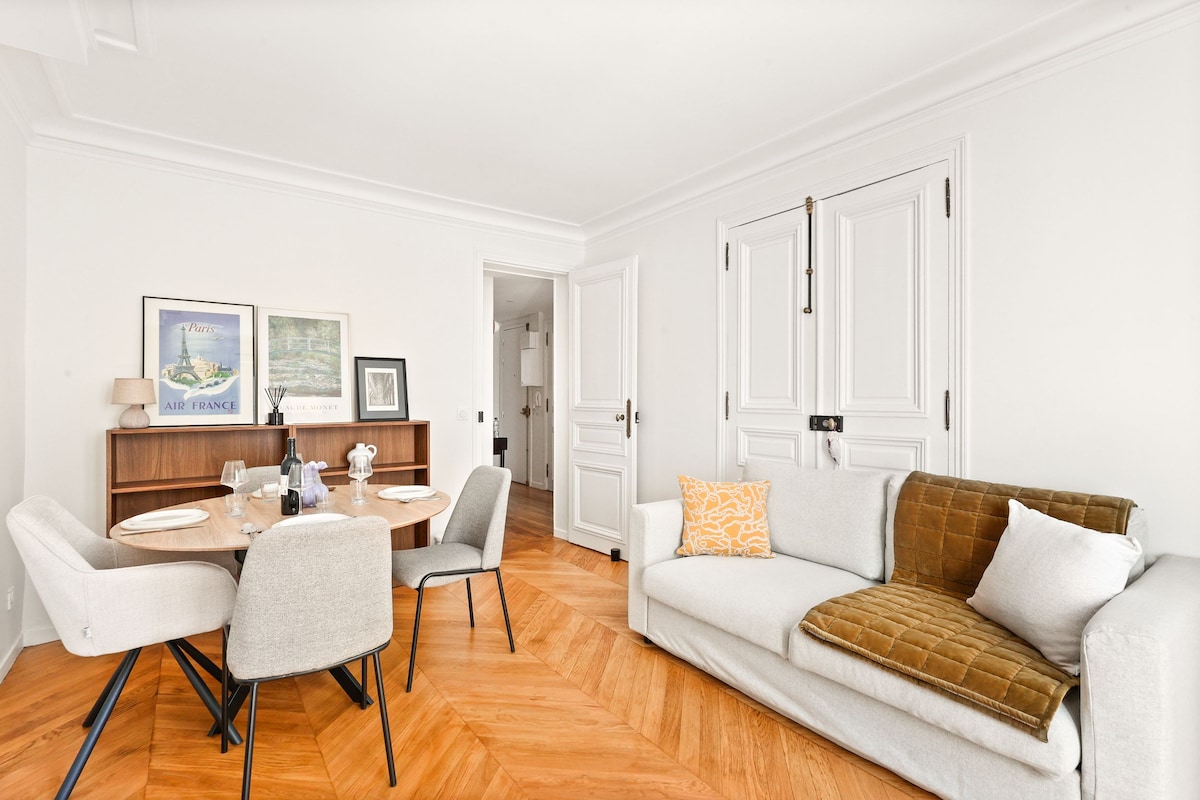
"Airbnb is over in Paris." You hear it everywhere since the Le Meur law. The reality is more nuanced — and far more strategic. No, short-term rental is not banned. Yes, it has become so restrictive that most owners would do well to reposition their property. Here is what really changes in 2026.
No, Airbnb is not banned in Paris
Let's clear up the ambiguity first: short-term rental remains perfectly legal in Paris. What has changed is the pile-up of conditions that make it hard to run as a main activity. Paris now enforces one of the strictest regulatory regimes in Europe, built on three pillars: the cap on nights, mandatory registration and change of use.
1. The cap on nights for a main residence
You can let your main residence (the one you live in at least 8 months a year) as a furnished tourist let, within a strict annual limit, combined across all platforms. The national cap was 120 nights; the Le Meur law of 19 November 2024 gave municipalities the power to lower it to 90 nights, and Paris has taken that route. The counter is applied automatically by the platforms.
To check for your property
The exact cap that applies depends on municipal decisions. Before planning your letting calendar, confirm the current threshold with the City of Paris.
2. Registration: the national Declaloc portal
Every listing must display a 13-digit registration number obtained after declaring the property at the town hall. The major development of 2026 is the rollout of the national Declaloc portal. Since 20 May 2026, owners must re-register on it — listings that have not been updated are removed by the platforms. It is the most tangible operational change of the year, and the one catching most owners off guard.
3. Change of use for second homes
To let short term a property that is not your main residence, you need a change-of-use authorisation, which in Paris comes with a compensation mechanism: converting an equivalent commercial surface into housing. The cost runs to several thousand euros per m² in the central arrondissements. It is an entry ticket that in practice reserves this model for the best-capitalised operators.
4. Energy ratings become a filter
Energy performance is gradually becoming a condition for accessing the market:
| Deadline | Rule |
|---|---|
| Since 2025 | Homes rated G can no longer be let short term |
| 1 January 2028 | Homes rated F must have been renovated |
| New authorisations | An energy rating of E or better is required for a change of use |
5. Penalties that change the equation
This is what makes breaking the rules fundamentally unprofitable. The fines can reach €10,000 for failing to register, €20,000 for a false declaration, and up to €100,000 for letting without a change-of-use authorisation. The platforms themselves are liable for each non-compliant listing. At the same time, the City of Paris has considerably stepped up its enforcement.
6. The tax side: the other blow
The Le Meur law also cut the micro-BIC benefits for furnished tourist lets: the allowance is reduced to 30% with a ceiling of €15,000 for an unclassified property (compared with 50% and €77,700 before), and 50% / €77,700 for a classified property. Above that, the actual-expenses regime becomes mandatory.
So what should you do with your Paris property in 2026?
The decision now has to be made property by property. Three scenarios dominate:
| Strategy | For whom | 2026 verdict |
|---|---|---|
| Main residence + capped short-term rental | Owner-occupier | Profitable but capped |
| Medium-term (civil or mobility lease) | Second home, investor | Often the best compromise |
| Short-term with a change of use | Well-capitalised operators | Very profitable, high entry ticket |
Medium-term rental captures precisely the demand that is shifting: relocating executives, expatriates, researchers, consultants on assignment. These tenants want a quality furnished home for a few months — exactly what short-term rental can no longer reliably offer them in Paris. It is also free from the night caps and change-of-use rules, and benefits from furnished-rental taxation that has remained unchanged.
⚠️ A framework that is still moving
Paris regulation is changing fast, and some rules (the cap on nights, the future of rent control) are still being decided. Always check the rules in force with the City of Paris, and have your arrangement validated by a professional before making any decision.
Full Concierge repositions your property safely
We support more than 110 Paris owners with these decisions, with more than 150 apartments under management. We analyse your property, your legal framework and your tax position, then propose the most profitable strategy. Free estimate within 24 hours.